New blogs cannot compete on high-volume keywords. A blog with zero backlinks and three months of content will not rank for "affiliate marketing" or "how to make money online." Those positions belong to sites with thousands of backlinks and years of authority.
The play for new blogs is to go small and specific. Low competition keywords with 100 to 1,000 monthly searches are winnable. They compound over time. And they build the authority you need to eventually compete for the bigger terms.
Here is how to find them.
What Makes a Keyword Low Competition
A keyword has low competition when:
- The sites currently ranking for it have low domain authority (below 40)
- The search results contain forum posts (Reddit, Quora) or thin content pages
- The query is a specific question rather than a broad topic
- Monthly search volume is between 100 and 3,000
Volume matters less than most people think. A keyword getting 200 searches per month that you can rank for in position 1 is worth more than a 10,000-volume keyword where you sit at position 47.
Method 1: Google Itself (Free)
Start with Google. Type your topic into the search bar and look at the autocomplete suggestions. Every suggestion is a real query that real people are searching for.
Then scroll to the bottom of the results page. "People also ask" and "Related searches" are gold. These are adjacent queries that share search intent with your main topic. Many of them have zero dedicated articles ranking for them.
The test: search the exact keyword. Look at the first three results. If they are from sites with clearly thin content, or from forum threads rather than dedicated articles, that is a signal the keyword is winnable.
Method 2: Ubersuggest Free Tier
Ubersuggest gives you 3 free searches per day. That is enough to build a keyword list over time without paying.
Enter a broad topic and look at the "Keyword Ideas" tab. Filter by:
- SD (SEO Difficulty) below 40. Anything above 60 is out of range for a new site.
- Monthly volume above 100. Below that, even ranking well may not bring meaningful traffic.
The sweet spot is SD 20 to 40 and volume 200 to 2,000. Sort by SD ascending and look for long-tail phrases, anything over four words tends to be more specific and less competitive.
Method 3: Reddit + AnswerThePublic (Free)
Go to a subreddit relevant to your niche. Filter posts by "Top" and "All Time." Look at the questions people ask repeatedly. Every repeated question is a keyword opportunity.
Then take those questions to AnswerThePublic (free, with a daily search limit). It generates every question variant of a seed keyword: who, what, when, why, how, which, where. Many of these variants have zero articles targeting them.
Pick the ones where the question sounds like something someone would type into Google exactly.
Method 4: Semrush Keyword Magic Tool (Paid)
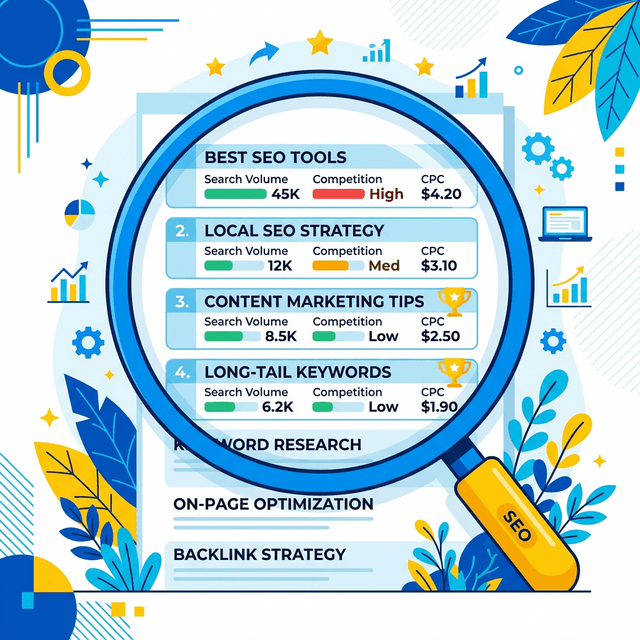
If you can invest in one SEO tool, Semrush is the most comprehensive. The Keyword Magic Tool lets you type in a seed keyword and get thousands of related terms with:
- Keyword Difficulty (KD) score
- Monthly search volume
- Cost-per-click (a proxy for commercial intent)
- SERP features the keyword triggers
Filter KD below 35 and volume above 100. Sort by volume descending. Export the list. You will find more low-competition opportunities in 20 minutes with Semrush than you would in a week of manual research.
The Pro plan costs $139.95 per month. That is only worth it if you are publishing regularly and treating SEO as a serious channel. If you are writing one article per month, use the free tools and upgrade later.
Method 5: Analyze What Is Already Ranking
Take any competitor article that ranks on page one and paste its URL into Semrush or Ahrefs. Look at what other keywords it ranks for. Often an article ranks for 20 to 50 different keyword variants, many of which have their own dedicated search intent and no dedicated article.
Those gaps are your opportunities.
The Filter That Matters Most
Search intent.
A keyword might look easy on paper but be impossible to rank for because Google has decided the result should always be a specific type of content. For example, "Python tutorial" will always return video content and comprehensive guides. A 500-word blog post will never rank for it, regardless of keyword difficulty.
Before targeting any keyword, look at what is already ranking. Ask: can I create something better than what is there? If the answer is yes and the content type matches what Google is serving, you have a real opportunity.
Building Your Keyword List
Aim for a list of 30 to 50 low-competition keywords before you start writing. Group them by topic cluster. Write the most specific ones first, then work up to the broader ones as your domain authority builds.
Track every article in a spreadsheet: the keyword, the target URL, the date published, the current ranking, and the traffic it generates. Review this monthly. The data tells you what to write next.
For context on how these fundamentals fit into a broader SEO strategy, read the 10 SEO basics that actually matter for new bloggers.