Your blog can have perfect on-page SEO on every single article and still rank nowhere. If your domain authority is low, Google does not trust you enough yet to put you on page one for competitive searches.
This article explains what domain authority actually measures, how it is calculated, and specifically what you should do to build it from zero.
What Domain Authority Is
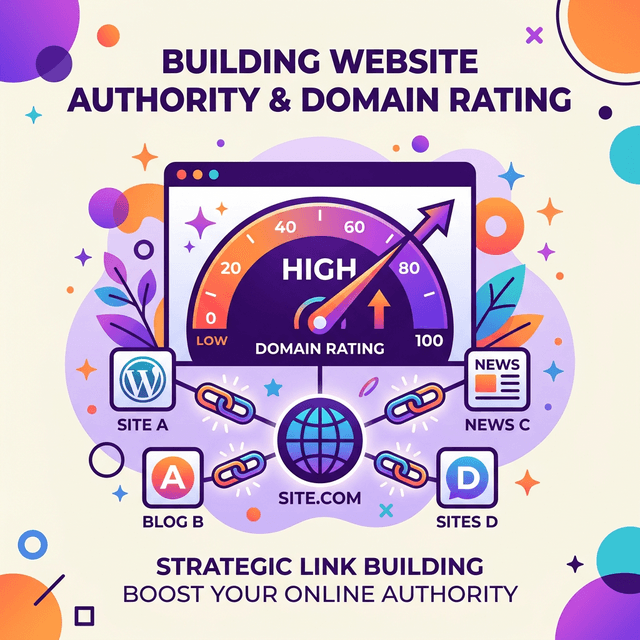
Domain authority (DA) is a score, developed by Moz, that predicts how well a website will rank in search results. It runs from 0 to 100. Higher is better. A new site starts at around 1. Most established blogs sit between 20 and 50. Sites like Wikipedia or The New York Times score in the 90s.
The term "domain authority" is specific to Moz. Ahrefs uses "Domain Rating" (DR) and Semrush uses "Authority Score." They all measure the same underlying thing: the quantity and quality of backlinks pointing to your site.
Google itself does not use any of these third-party scores directly. But they are useful proxies because they correlate with what Google actually cares about: trusted, relevant external sites linking to yours.
Why It Matters for New Blogs
There are two types of SEO you can control:
On-page SEO: Title tags, meta descriptions, heading structure, content quality. You control all of this.
Off-page SEO: Backlinks from other sites. You influence this but cannot fully control it.
On-page SEO gets you to the table. Off-page SEO determines whether you win. A blog with great content and zero backlinks will lose to a mediocre article on a site with 50 authoritative backlinks pointing to it, for competitive keywords.
For low-competition keywords, on-page quality can be enough. As you target more valuable keywords, off-page becomes the deciding factor.
How to Check Your Domain Authority
Three ways:
- Moz Link Explorer (free account, limited searches): moz.com/link-explorer
- Ahrefs Webmaster Tools (free for your own site): ahrefs.com/webmaster-tools
- Semrush (paid, but shows DR for any domain): semrush.com
Check your DA when you launch, then check it monthly. Do not obsess over it weekly. It moves slowly, especially in the first six months.
What Actually Builds Domain Authority
One thing: earning links from other websites that Google already trusts.
Not all links are equal. A single link from Forbes does more for your DA than 100 links from new blogs no one has heard of. A link from a relevant blog in your niche is worth more than a link from an unrelated high-DA site.
Links from sites with low DA and no organic traffic do nothing.
Method 1: Create Content Worth Linking To
The most sustainable way to earn backlinks is to publish something that no one else has. That could be:
- Original data or research you ran yourself
- A comprehensive guide that covers something more thoroughly than anything else ranking
- A resource page (a curated list of tools, links, or references) that saves people time
- A case study with real numbers
When someone finds your content useful, they link to it from their own articles. This happens naturally over time if you prioritise quality over volume.
Method 2: Guest Posting
Write articles for other blogs in your niche. Include one link back to your site in the author bio or, if the editor allows it, within the content.
The key is targeting blogs that have real organic traffic and a DA above 30. Guest posting on DA 5 blogs gives you almost nothing. Guest posting on DA 40 to 60 blogs moves the needle meaningfully.
Find opportunities by searching: your niche + "write for us" or your niche + "guest post" in Google.
Method 3: Digital PR and Resource Pages
Many websites maintain resource pages, lists of external links they recommend on a topic. These are passive link opportunities. Find them by searching: your niche + "useful resources" or "links" + your topic.
Email the webmaster, introduce yourself, and ask if your article would be a relevant addition. Keep the email short. Most will not reply, but a 10 percent success rate still earns you real links.
Method 4: Broken Link Building
Find broken links on other sites in your niche and offer your content as a replacement.
Use Ahrefs or Check My Links (a free Chrome extension) to find broken links on relevant pages. Email the site owner, let them know the link is dead, and suggest your relevant article as a replacement.
This converts at a higher rate than cold guest post outreach because you are solving a problem for them.
What Not to Do
Do not buy links. Google's spam team is good at detecting link schemes and will penalise your site. Paid links are not worth the risk.
Do not spam blog comment sections with your URL. These links are tagged "nofollow" and pass no authority.
Do not join link exchange groups where sites trade links with each other. Google explicitly discounts reciprocal links and may penalise excessive link swap activity.
Timeline for Building Domain Authority
Month 1 to 3: DA stays near 0 to 5. Focus entirely on publishing quality content and doing the foundational on-page work.
Month 3 to 6: If you have been doing guest posts or earned a few natural links, you might see DA move to 10 to 20.
Month 6 to 12: With consistent link building, 20 to 35 is realistic for an active blog.
Year 2 and beyond: DA 40 to 60 is achievable for blogs in most niches with a focused link-building strategy.
These are rough estimates. Niche matters. Competition level matters. Consistency matters most.
For more on the fundamental building blocks before you think about backlinks, read the 10 SEO basics every blogger needs to know.