Here is the sequence most new bloggers follow:
Build the site. Write the articles. Wait for Google. Wonder why nothing is happening.
Then they either quit or pivot to a completely different niche, convinced the problem is their topic, their writing, or their niche. The problem is almost never any of those things. The problem is the order of operations.
Google takes three to six months to trust a new domain. That is not speculation. It is a well-documented behavior called the Google sandbox, and it means that even a perfectly written, perfectly optimized article on a brand new site will sit with almost zero organic traffic for months while Google evaluates whether your domain is legitimate.
Most bloggers do not know this going in. They publish twenty articles, see nothing in Google Search Console, and conclude that blogging does not work.
Blogging works. The sequence was wrong.
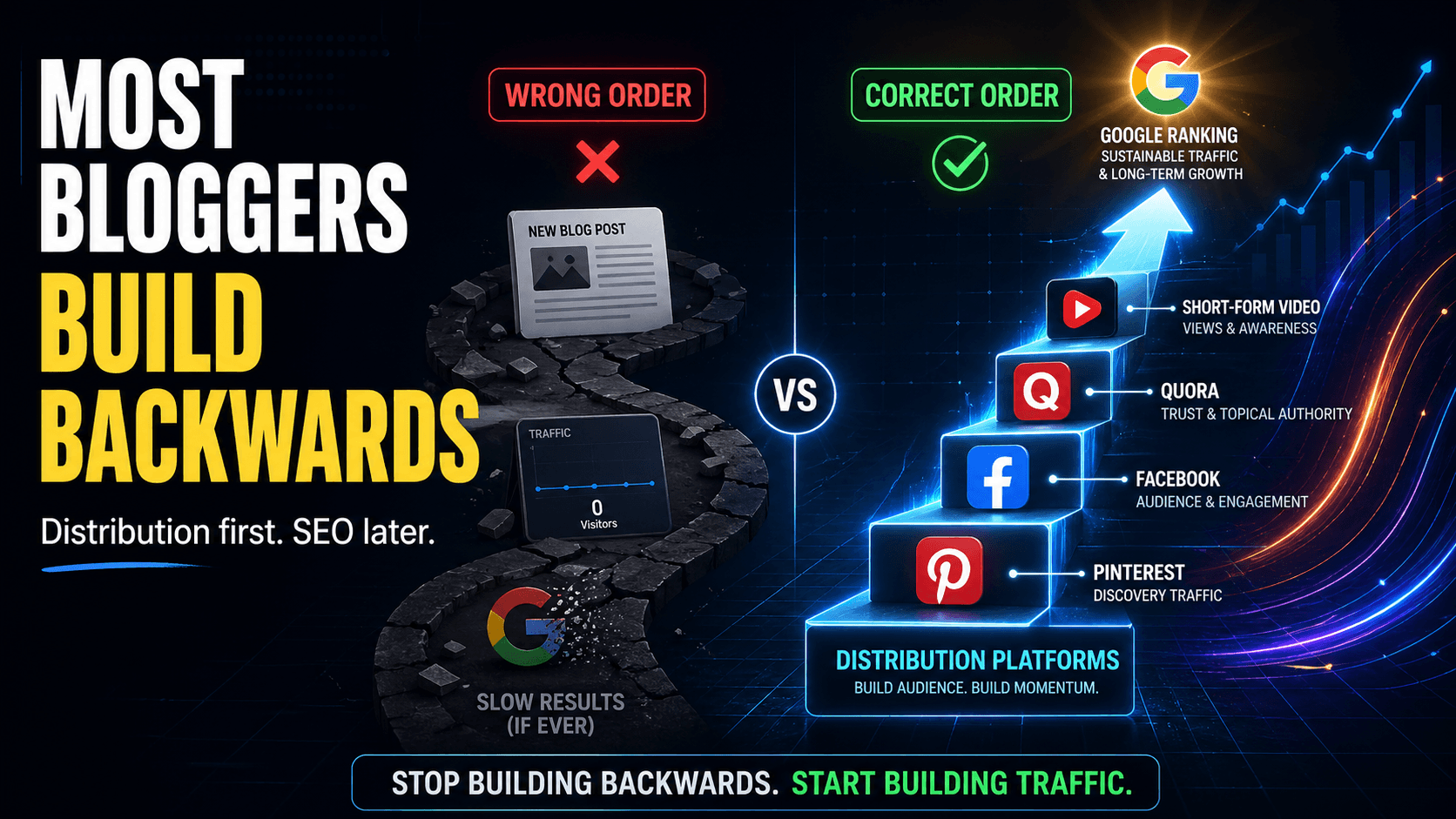
In 2026, traffic does not start with SEO. It starts with distribution. And once you understand that distinction, everything about how you build a blog changes.
Why Google Is No Longer Step One
This is not a claim that SEO is dead. SEO is not dead and anyone telling you it is either quit too early or never understood it properly.
What has changed is where SEO sits in the sequence.
For an established blog with domain authority, existing backlinks, and a track record of ranking content, SEO is the primary traffic engine. Google trusts that domain and rewards new content quickly.
For a brand new blog with no history, no backlinks, and no domain authority, SEO is a delayed reward. You do the work now and Google pays it back six to twelve months later. That is the deal. It is still a good deal in the long run. It is just not the right starting point.
The correct starting point is a platform that does not penalize new accounts for being new.
Pinterest does not care that your domain registered last month. Facebook groups do not require a Domain Rating to let you participate. Quora does not check your backlink profile before showing your answer to searchers. These platforms are accessible from day one in a way that Google organic search simply is not.
Build attention first. Then send it to your blog. Then let Google catch up to what you have already proven works.
The Five Distribution Channels That Work Right Now
1. Pinterest (Still the Most Underrated Traffic Source for Bloggers)
Pinterest is a visual search engine, not a social media platform. That distinction matters because it changes how content compounds over time.
A post you share on Instagram or Facebook has a lifespan measured in hours. A pin you publish on Pinterest can appear in search results six months from now with no additional effort. The content ages like a blog post, not like a social update.
For bloggers in visual or helpful niches, which covers gardening, DIY, food, home, wellness, personal finance, blogging, and side hustles, Pinterest can send real traffic within days of publishing a pin. Not weeks. Not after building a following. Days.
I know this from running it directly. A fresh Pinterest account with zero followers, attached to a brand new gardening blog, crossed 200,000 monthly impressions in under four months through consistent pinning alone. No ads. No influencer partnerships. No existing audience. Just a systematic pinning strategy applied from day one.
The full breakdown of how that growth happened, including which board broke out first and when the compounding started, is documented here: How I Got 200,000 Pinterest Impressions in Under 4 Months.
Pinterest is step one for any new blog in a visual or helpful niche. If your content can be represented in a vertical image with a clear headline, you belong on Pinterest before you belong anywhere else.
What to do: Set up a Pinterest business account, claim your website, create five focused boards with keyword-rich descriptions, and publish three to five fresh pins per day linking to your blog posts. The exact setup process is here.
2. Facebook Groups (Where the Attention Already Exists)
Facebook groups are one of the most consistently underused traffic sources for new bloggers because they require a different skill than content creation. They require participation.
Every niche has active Facebook groups with thousands of engaged members who are already interested in exactly what your blog covers. Those groups are pools of pre-qualified readers. You do not need to build an audience from scratch. You need to show up in the groups where the audience already exists and provide enough value that people want to know more about where you come from.
The mechanics are straightforward. Join five to ten active groups in your niche. Read the posts. Answer questions thoroughly and helpfully. When you have a blog post that directly answers a question someone has asked, mention it naturally in the context of your answer. Do not drop links without context. Groups penalize that immediately. Provide the answer first, the link second and only when it adds genuine value to the conversation.
Facebook group traffic is not passive in the way Pinterest traffic is. It requires consistent showing up. The payoff is that it works immediately and builds real relationships with readers who are likely to return to your blog, subscribe to your email list, and share your content.
3. Quora (A Long-Term Passive Traffic Machine Most Bloggers Ignore)
Quora sits in an unusual position in the traffic ecosystem. Quora answers rank on Google. A well-written Quora answer targeting a specific question can appear in Google search results for years, sending traffic both directly from Quora and indirectly through Google.
That combination makes Quora one of the few platforms where a single piece of content can generate passive traffic without requiring you to build a following on the platform itself.
The approach that works is not answering questions randomly. It is identifying questions on Quora that match the exact topics your blog covers, writing thorough answers that genuinely solve the problem, and including a natural reference to your blog post when it adds value to the answer.
The key phrase is when it adds value. A Quora answer that exists primarily to drop a link gets collapsed by moderators and ignored by readers. A Quora answer that is genuinely the best answer to that question, and happens to mention that you wrote a full guide on the topic, gets upvoted, followed, and clicked for years.
For a new blogger, Quora is one of the fastest ways to get content ranking in Google without any domain authority on your own site. Google trusts Quora. That trust transfers to the visibility of your answers.
4. Short-Form Video (The Fastest Way to Validate Blog Topics)
TikTok, Instagram Reels, and YouTube Shorts are not just distribution channels. They are the fastest available tool for testing whether a blog topic has real audience demand before you invest hours writing a full article about it.
A short-form video on a topic takes thirty minutes to produce. If it gets meaningful engagement, the topic has proven demand. Write the full article. If it gets nothing, move on without having spent half a day writing something nobody wants.
That validation loop is the practical reason short-form video belongs in a blogger's workflow in 2026, even if video is not your primary format. Use it as a research and validation tool first. Distribution channel second.
The additional benefit is that short-form content drives direct traffic to your blog when you have a specific, useful piece of content to reference. A fifteen-second Reel that says "I documented exactly how I got 200,000 Pinterest impressions in four months on a brand new blog, link in bio" sends a specific interested audience to a specific article. That is more effective than a general "check out my blog" CTA.
5. Google (Still Essential, Now Just Delayed)
Everything above is a bridge. Google is the destination.
Pinterest traffic compresses. Platforms change their algorithms. Facebook groups require ongoing participation. Quora traffic fluctuates. Google organic traffic, once established, is the most durable and scalable traffic source available to a blogger. Articles that rank on Google send traffic every day without any ongoing effort. That is the compounding that makes blogging a legitimate long-term income model.
The strategic shift is not abandoning SEO. It is doing SEO from the beginning while using other platforms to generate traffic during the months Google is evaluating your domain.
Every article you publish should still be keyword-targeted. Every post should still be optimized for search intent. The difference is that you are not waiting for Google to be your only traffic source. You are building a multi-channel distribution system where Google eventually becomes the dominant channel, having arrived later than Pinterest and Quora but ultimately producing more traffic than both.
I documented what this combined approach produces in real numbers here: What 1,000 Hours of Blogging Actually Produces.
The New Rule for Building a Blog in 2026
Do not build content and wait to be found. Build content and immediately distribute it everywhere your audience already exists.
Pinterest for visual discovery. Facebook groups for community distribution. Quora for search-adjacent passive traffic. Short-form video for validation and direct traffic. Google SEO running in the background the entire time, compounding quietly, ready to become your primary source in six to twelve months.
The bloggers who are winning in 2026 are not necessarily the ones with the best SEO. They are the ones who understood that distribution is what makes content valuable and built multi-channel systems from day one instead of month six.
Your blog is not a destination people will find by accident. It is a destination you send people to, from everywhere you can reach them, until Google takes over the job permanently.
What to Actually Do This Week
If your blog is under six months old and your only traffic strategy is SEO, here is the priority order:
Set up Pinterest and start pinning today. This is the fastest return for the time invested and the one most directly connected to early blog income through AdSense and affiliate links. The complete Pinterest setup guide for bloggers covers every step.
Join three Facebook groups in your niche and participate genuinely for two weeks before you share a single link.
Find five Quora questions that your existing blog posts directly answer and write thorough answers for each one this week.
Keep publishing keyword-targeted articles consistently. Google will catch up. Your job is to make sure the blog is still alive and growing when it does.
The sequence matters. Distribution first, then SEO rewards you for the work you already did.
FAQ
Does SEO still work for new blogs in 2026?
Yes, but with a delayed timeline. New domains typically spend three to six months in what the SEO community calls the Google sandbox, a trust evaluation period where even well-optimized content sees minimal organic traffic. SEO should start from day one, but it should not be your only traffic strategy during that period.
Is Pinterest worth it for a blog in 2026?
For blogs in visual or helpful niches, Pinterest remains one of the most effective early-stage traffic sources available. It does not penalize new accounts and pins compound in visibility over time in a way that social media posts do not. The full case for Pinterest as a traffic source is here.
How long does it take to get blog traffic from Pinterest?
A well-optimized pin linking to a relevant article can appear in Pinterest search results within days of being published. Meaningful traffic to your blog typically starts building within thirty to sixty days of consistent daily pinning. Significant impression volume, in the range of tens of thousands per month, typically develops within three to four months on a new account.
What is the fastest way to get traffic to a new blog?
Pinterest and active participation in relevant Facebook groups are the fastest routes to real traffic for a new blog with no existing audience and no domain authority. Both are accessible from day one and neither requires ranking on Google first.
Can I make money from a blog before Google ranks it?
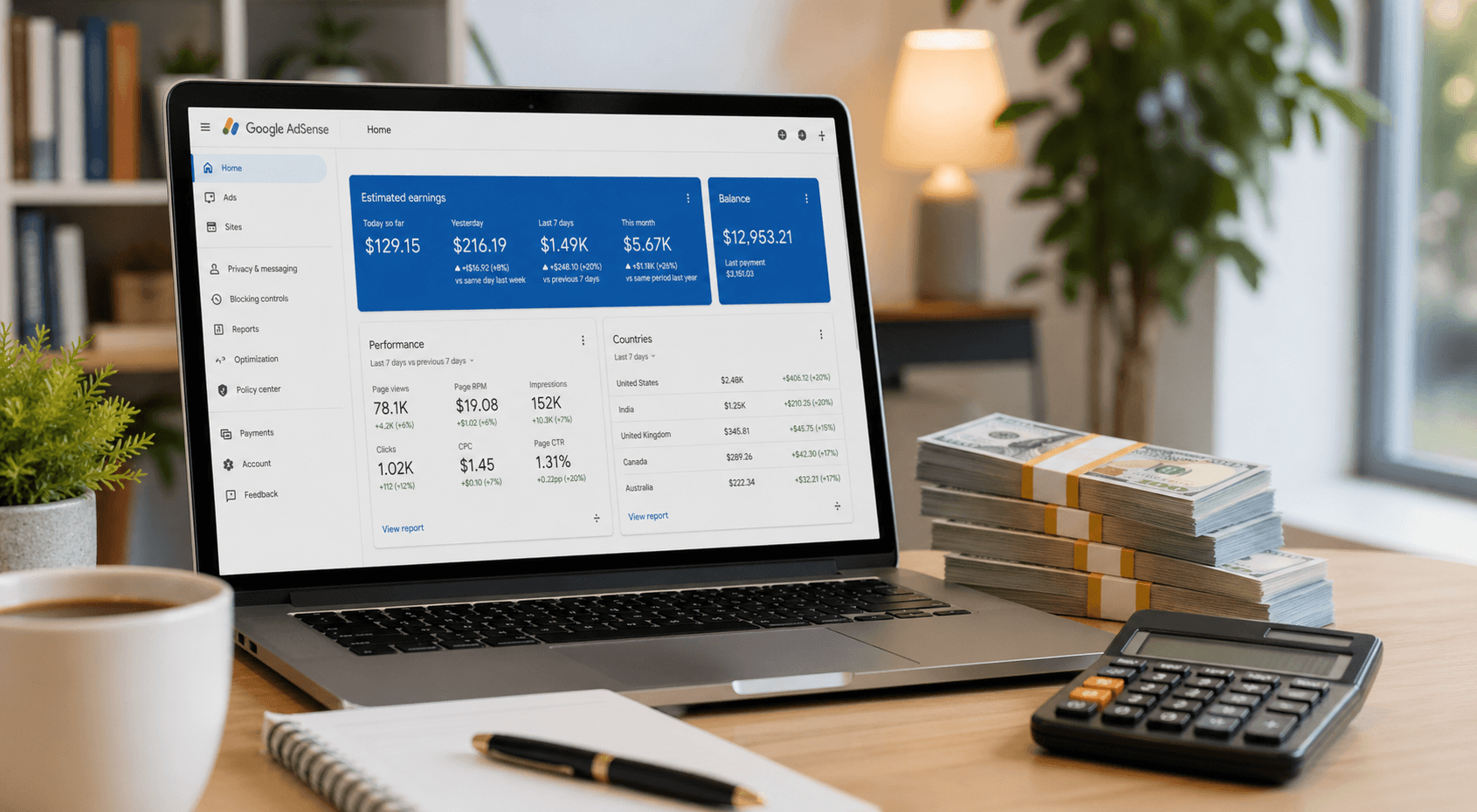
Yes. Display advertising through Google AdSense and affiliate commissions through programs like Amazon Associates both generate income from any real traffic, regardless of its source. A blog earning Pinterest traffic from month one can be monetized from month one. How that plays out in practice is documented here.
Kamal Deen builds niche blogs and grows them with Pinterest and SEO. Everything documented in this article comes from his own sites with real numbers.
Related reading:
- How I Got 200,000 Pinterest Impressions in Under 4 Months (Fresh Account, Real Numbers)
- How to Set Up a Pinterest Business Account for a Blog (Step by Step)
- Can You Make Money on Pinterest by Posting Pictures?
- What 1,000 Hours of Blogging Actually Produces (A Realistic Case Study)
- How I Got Google AdSense Approved in Under 5 Months (Gardening Blog, Real Numbers)
- 50 Passive Income Ideas: What Actually Pays (Ranked by Realistic Earnings in 2026)