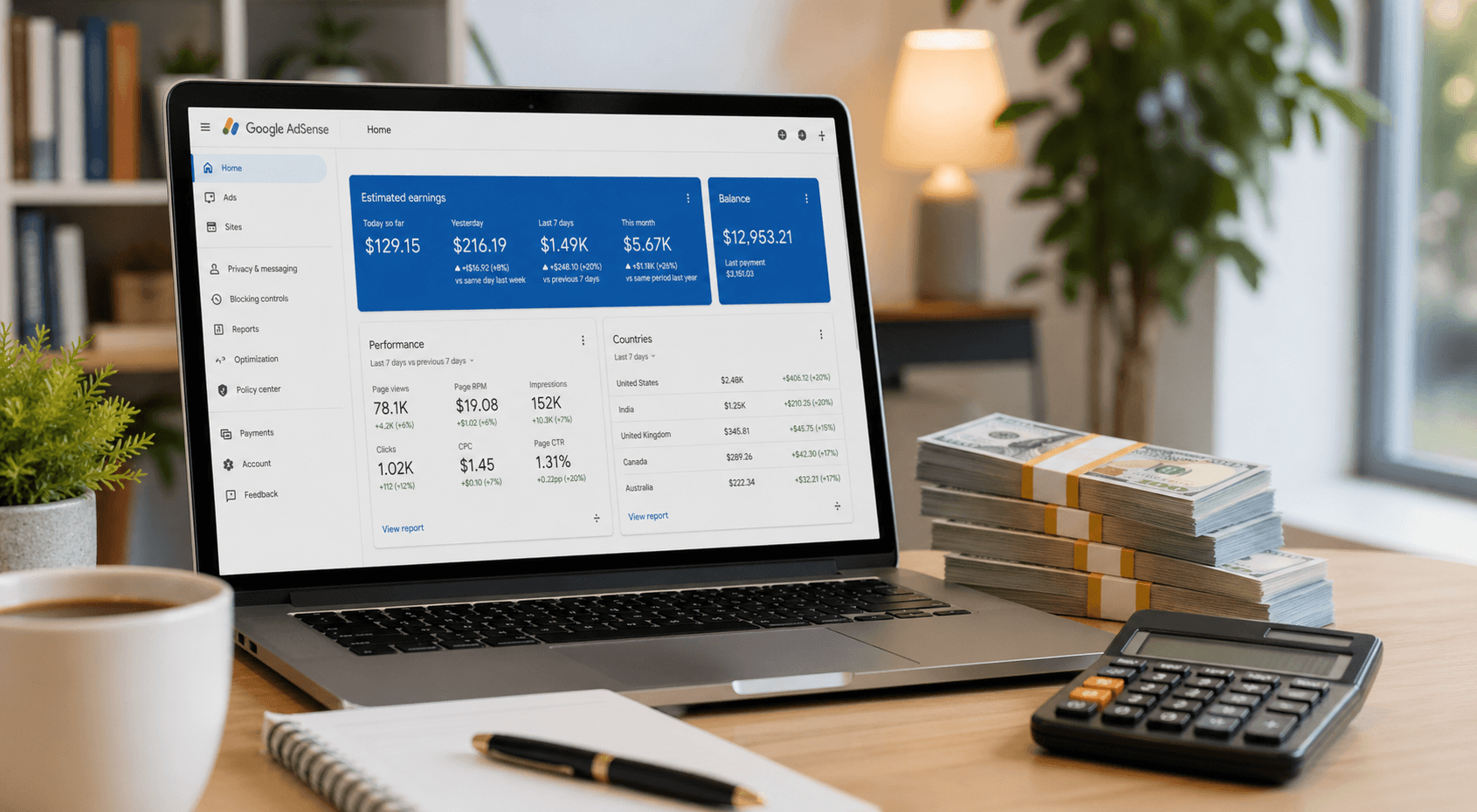
My gardening blog earned $19.82 in its first monetized month on Google AdSense.
3,000 to 5,000 pageviews. Mostly US traffic. A five-month-old site that Google was still figuring out. Nineteen dollars and eighty-two cents.
I am telling you that number first because every article on this topic either gives you vague ranges that mean nothing or inflated success stories that make you feel behind. Neither is useful. What is useful is knowing what a real new blog actually earns so you can set correct expectations, build the right strategy, and stop chasing numbers that do not apply to your situation yet.
Here is the complete honest picture of how much money you can make with Google AdSense, from the first dollar to the point where it becomes a serious income stream.
How AdSense Actually Pays You
Before getting into the numbers, understanding the payment mechanism changes how you think about growing your income.
AdSense pays through two models running simultaneously on your site.
CPC (Cost Per Click): Every time a visitor clicks an ad on your page, you earn a cut of what the advertiser paid for that click. Click values vary enormously by niche. A click on a finance ad might be worth $3 to $8. A click on a gardening ad might be worth $0.20 to $0.80. The advertiser sets the bid based on what a converted customer is worth to their business. You have no control over CPC. You can influence it by choosing content topics that attract higher-paying advertisers.
CPM (Cost Per Thousand Impressions): You also earn a small amount every time an ad is displayed, regardless of whether anyone clicks. This is called an impression payment and it adds up across high-traffic pages even when click rates are low.
Your overall earnings are measured as RPM, which stands for Revenue Per Mille, or revenue per thousand pageviews. RPM combines both CPC and CPM into a single number that tells you how much your site earns for every 1,000 visitors. This is the number to watch. Not clicks. Not impressions. RPM.
On the low end, AdSense RPM sits between $2 and $5. The medium range runs from $5 to $10. High-performing niches can reach $50 or more. My gardening blog was earning in the $4 to $6 RPM range in month one, which is exactly where a new site with US-dominant traffic in a mid-value niche should land.
What Determines How Much You Actually Earn
Five factors control your AdSense income. Traffic volume is the most obvious one. It is also the least interesting one because it is the slowest to change. The other four move faster and have a bigger impact on your monthly check than most bloggers realize.
1. Your niche
High-value niches like insurance, legal, and finance command $20 to $45 RPM because advertisers in those industries have extremely high customer lifetime values. Entertainment and gaming blogs may earn only $0.05 to $4 RPM for the same traffic volume.
Blogging, SEO, and online business content sits in a strong middle tier. Advertisers selling tools, courses, and software pay meaningfully more per click than advertisers selling physical products or entertainment content. If you are writing about how to make money online, the ads serving on your pages are from companies who understand the value of a click from someone actively trying to build income.
2. Traffic geography
Where your readers come from affects your RPM more than most bloggers expect. US, UK, Canadian, and Australian traffic monetizes at significantly higher rates than traffic from most other regions. Advertisers pay more to reach audiences in high-purchasing-power countries.
My gardening blog's mostly US traffic in month one is the primary reason it earned $19.82 on 3,000 to 5,000 pageviews instead of $4. The same pageview count with primarily Indian or Southeast Asian traffic might have earned $3 to $6 total.
Pinterest is particularly valuable here. Pinterest's user base skews heavily toward US audiences, which means Pinterest-driven traffic tends to monetize better on AdSense than traffic from many other platforms. This is one of the underappreciated advantages of the Pinterest-first strategy for new blogs. The traffic source matters as much as the volume.
3. Ad placement
Strategically placing ads where eyes naturally go, after the first paragraph, beside key content, or as sticky banners on mobile, directly impacts earnings. One finance writer increased earnings 70% just by moving ads higher on his pages.
The first ad placement above the fold on any page generates the highest click-through rates. Ads buried below long paragraphs get fewer views and fewer clicks. Most new bloggers accept AdSense's default automatic placement. Switching to manual placement through a plugin like Ad Inserter and positioning your first ad unit directly after the opening section of each article produces measurably better results without touching your traffic numbers at all.
4. Content type and search intent
Not all traffic is equal in AdSense terms. A visitor who landed on your site by searching "best email marketing software for bloggers" is in buying mode. The ads serving on that page are from email marketing companies competing for that visitor's attention with high bids. Your CPC on that page might be $2 to $4 per click.
A visitor who landed on your site by searching "what is email marketing" is in learning mode. Lower advertiser bids. Lower CPC. Same traffic number, different income.
Writing content that attracts searchers with commercial intent, meaning people comparing options, looking for recommendations, or preparing to buy something, increases your RPM without increasing your traffic.
5. Session depth
A site where readers average 3 pages per visit earns roughly three times as much from AdSense as a site where readers view only 1 page, even with identical traffic volumes and ad rates.
Internal linking drives session depth. Every internal link you add to a post is an invitation for the reader to stay on your site longer, see more pages, and generate more ad impressions. This is why the topical cluster structure that powers kamaldeen.com's content architecture improves ad income alongside SEO performance. A reader who lands on the pillar post and navigates through three or four spoke articles is generating three or four times the ad revenue of a reader who reads one page and leaves.
Realistic AdSense Earnings by Traffic Level
Here is what the numbers actually look like across different traffic levels, using realistic RPM ranges rather than best-case scenarios.
| Monthly Pageviews | Low RPM ($3) | Mid RPM ($6) | High RPM ($12) |
|---|---|---|---|
| 1,000 | $3 | $6 | $12 |
| 5,000 | $15 | $30 | $60 |
| 10,000 | $30 | $60 | $120 |
| 25,000 | $75 | $150 | $300 |
| 50,000 | $150 | $300 | $600 |
| 100,000 | $300 | $600 | $1,200 |
The low RPM column represents new sites with mixed international traffic in general niches. The mid RPM column represents established sites with US-dominant traffic in mid-value niches like blogging, gardening, wellness, and lifestyle. The high RPM column represents sites in high-value niches like personal finance, software, and legal content with primarily US and UK traffic.
My gardening blog at 3,000 to 5,000 pageviews and $19.82 earned was operating at a mid-RPM of approximately $4.50, exactly where the model predicts a new US-traffic gardening site should perform.
Real Case Studies: What Bloggers Actually Earn
Case Study 1: New gardening and wellness blog, month one
Site: barksecret.com (my own site) Monthly pageviews: 3,000 to 5,000 Traffic source: Primarily Pinterest, mostly US RPM: Approximately $4.50 Month one AdSense earnings: $19.82
This is what a legitimate new blog earns in month one. Not $500. Not $2,000. Nineteen dollars. The value of month one is not the income. It is the proof of concept. The RPM data tells you what the site will earn at 10x the traffic, 50x the traffic, and 100x the traffic. At a $4.50 RPM and 50,000 monthly pageviews, this site earns $225 per month from AdSense alone. At 100,000 pageviews, $450. The month one number is the seed. The traffic growth is the water.
Case Study 2: Mid-stage blogging and SEO niche site
A site in a mid-value niche targeting US and UK audiences with 10,000 monthly pageviews can realistically expect $50 to $150 per month from AdSense. At this stage, the site is approaching Mediavine Journey eligibility at 1,000 sessions, which would likely double or triple the RPM overnight without a single additional pageview.
Case Study 3: Finance blogger with high-intent content
A finance blog with 100,000 monthly pageviews and predominantly US traffic earns $1,500 to $4,000 per month from AdSense. This is what commercial intent content in a high-CPC niche produces. The same 100,000 pageviews on an entertainment site earns $200 to $500. Same traffic. Vastly different income. Niche selection compounds over years in ways that are difficult to undo.
Case Study 4: The blogger who 10x'd RPM without touching traffic
One publisher took their RPM from $4 to $40 over several months by shifting content toward tier-one country audiences, optimizing ad placement, and breaking content into shorter scannable paragraphs that created more natural ad placement opportunities. Traffic barely changed. Income multiplied tenfold. RPM optimization is consistently undervalued relative to traffic growth as an income lever.
The AdSense Income Ceiling and When to Leave
AdSense is the right starting point. It is not the final destination.
Mediavine Journey, which requires just 1,000 monthly sessions as of January 2026, reports average RPMs of $10 to $15, and some publishers in premium niches are seeing $30 or more. That is a two to three times income increase on the exact same traffic the moment you switch.
Raptive, which recently lowered its entry requirement to 25,000 monthly pageviews, reports publishers seeing average RPMs of $47 or more, significantly outpacing what most Mediavine publishers earn.
The progression that makes mathematical sense for most bloggers:
Start on AdSense from approval. Apply to Journey by Mediavine at 1,000 sessions. Move to Mediavine Official when annual ad revenue crosses $5,000. Evaluate Raptive at 25,000 monthly pageviews.
Each transition is a meaningful income jump on identical traffic. The bloggers who stay on AdSense at 50,000 monthly pageviews because switching feels complicated are leaving hundreds of dollars per month on the table indefinitely. I documented the full AdSense approval process, including exactly what Google's reviewers are looking for and how to make the application straightforward, here: How I Got Google AdSense Approved in Under 5 Months.
How Long Until AdSense Pays Meaningfully
This is the question most people are actually asking when they search how much money they can make with Google AdSense. They want to know when it becomes real income, not just gas money.
The honest timeline:
Month 1 to 3: $5 to $50 per month. This is proof of concept, not income. Your traffic is low, your RPM is establishing itself, and Google is still evaluating your domain. This period is where most bloggers give up because the number feels insulting relative to the work they are putting in. The work done in this period is the foundation for every dollar earned in month 12.
Month 4 to 6: $30 to $200 per month. Traffic is compounding from early content. Pinterest is sending consistent visitors if you built that channel. Google is starting to rank your better-optimized posts. RPM is climbing as Google's system better understands your audience and serves more relevant, higher-paying ads.
Month 7 to 12: $100 to $600 per month. The blogs that maintained publishing consistency and did not pivot away from their niche start seeing real compounding here. Google traffic stacks on top of Pinterest traffic. Internal links are driving session depth. RPM reflects an established site rather than a new one.
Month 12 to 24: $300 to $2,000+ per month. The range widens dramatically here based on niche, traffic source quality, whether you upgraded ad networks, and how aggressively you built topical authority. Blogs that followed a systematic cluster approach and upgraded to Journey or Mediavine by this point are earning meaningfully.
None of these numbers are guaranteed. They reflect what happens when the inputs are right: consistent publishing, low-competition keyword targeting, US-dominant traffic sources, and an ad setup that does not actively hurt user experience.
Use These Free Tools to Calculate Your Own Numbers
Every number in this post is an estimate until you run it against your own traffic data. These free tools on this site do the calculation for you:
Blog Income Calculator — Enter your monthly pageviews, niche, and traffic geography and get a realistic AdSense income estimate alongside projections for Mediavine Journey and Raptive. Shows you exactly how much more you would earn by switching networks at your current traffic level.
Ad Network Qualification Checker — Enter your current monthly sessions and the tool tells you which ad networks you qualify for right now, which ones you are close to, and the exact session gap between you and each threshold. Useful before you apply anywhere.
Running your own numbers through these takes about two minutes and gives you a clearer picture than any generic estimate in any article, including this one.
Three Things That Raise Your AdSense Income Without Touching Traffic
Switch to manual ad placement. Automatic ads often place units in locations that generate low viewability and low clicks. Manual placement through Ad Inserter or a similar plugin lets you put your highest-performing ad unit directly after your opening section where engagement is highest.
Write more commercial intent content. Review posts, comparison posts, and best-of lists attract advertisers with higher CPC bids. Adding two or three commercial intent posts per month into a primarily informational content calendar measurably increases RPM across the site over time.
Increase session depth through internal linking. Every post should link to at least three other posts on your site. Every reader who views two pages instead of one doubles your ad revenue from that visit. Internal linking is the highest-leverage low-effort RPM improvement available on any blog regardless of its traffic level. The full internal linking strategy behind the cluster approach is explained here: Most New Bloggers Are Still Building Backwards in 2026.
The Real Answer to the Question
How much money can you make with Google AdSense?
In month one on a new blog with 3,000 to 5,000 pageviews and good US traffic: $19.82.
At 10,000 monthly pageviews in a mid-value niche with US traffic: $50 to $120.
At 50,000 monthly pageviews after upgrading to Mediavine: $500 to $750.
At 100,000 monthly pageviews in a high-value niche on Raptive: $3,000 to $5,000.
The ceiling is not AdSense. The ceiling is your traffic, your niche, your traffic quality, and which network you are on. AdSense is where you start. The number it pays you in month one is not the number it represents in month twelve. And month twelve is not the ceiling either.
The bloggers who quit because $19.82 felt like nothing never found out what $19.82 compounds into.
Kamal Deen builds niche blogs and monetizes them with display ads and affiliate marketing. The earnings referenced in this article come from his own sites with unedited numbers.
Related reading:
- How I Got Google AdSense Approved in Under 5 Months (Gardening Blog, Real Numbers)
- How I Got 200,000 Pinterest Impressions in Under 4 Months (Fresh Account, Real Numbers)
- Most New Bloggers Are Still Building Backwards in 2026
- Can You Make Money on Pinterest by Posting Pictures?
- 50 Passive Income Ideas: What Actually Pays (Ranked by Realistic Earnings in 2026)
Free tools: