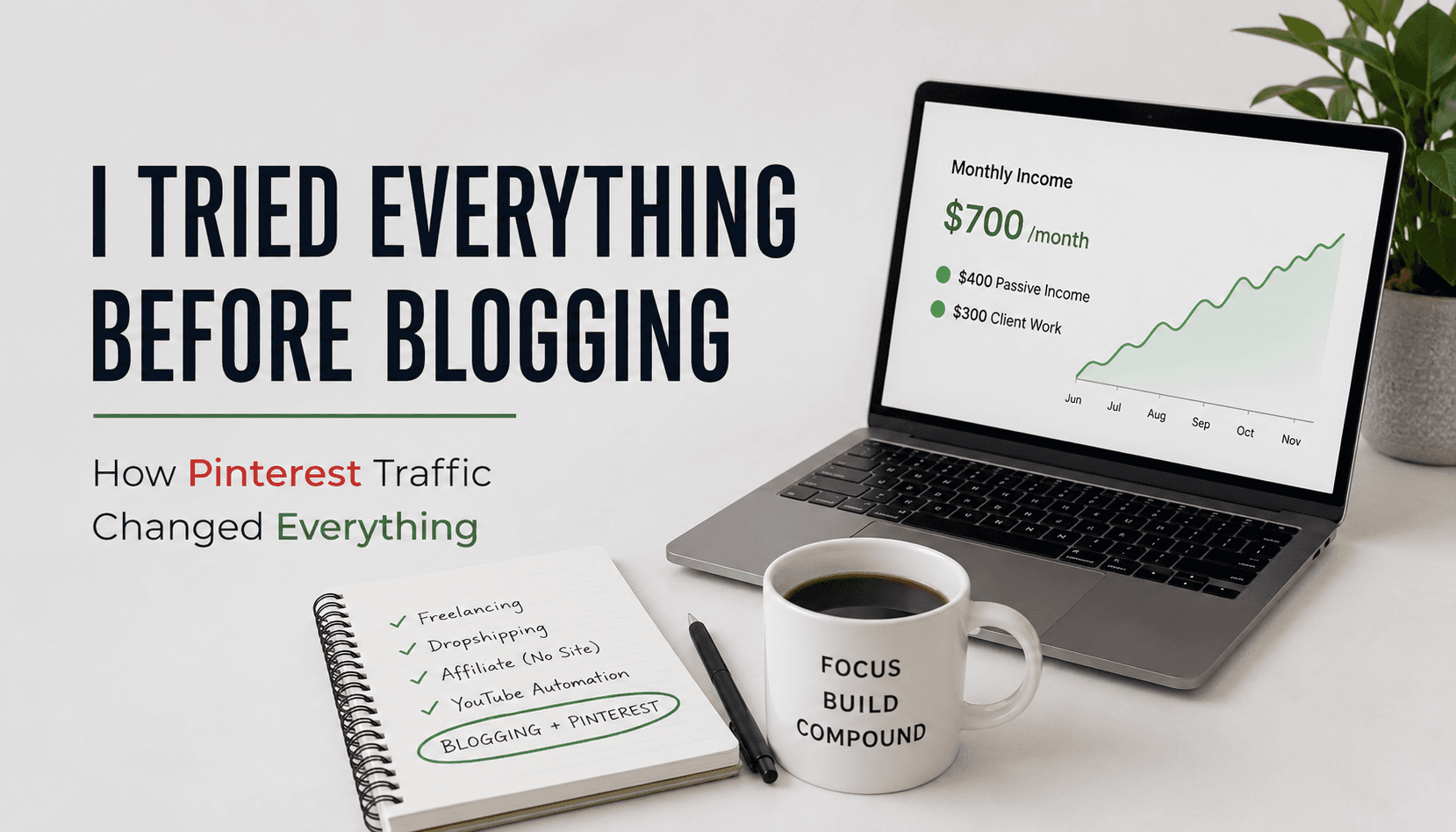
Three months of cold DMs and Fiverr gigs earned me $70. That was 2022. Today my blogs earn around $400 a month passively, with another $300 on top from client work, and I have not sent a single cold pitch to get any of it. Here is the full story of every method I tried before blogging finally made sense.
Every make money online video follows the same format. A thumbnail with a shocked face and a number. A story about going from zero to something life-changing. A strategy that sounds deceptively simple. I watched dozens of them. I tried the methods they recommended. Most of them did not work for me, not because the methods are fraudulent, but because nobody tells you what the experience of actually trying them looks like from the inside.
This post is that inside account. What I tried, how long I actually gave each thing, what it produced, and why blogging with Pinterest as the traffic source ended up being the one that clicked. I am writing this because I made every mistake the hard way, and this site exists specifically so you do not have to.
The Methods I Tried Before Blogging
Attempt 01 — Freelancing: Three months on Fiverr for one client and $70
I listed a WordPress gig on Fiverr in 2022. My thinking was straightforward: I have a programming background, I understand how websites work, there must be people who need that. I was right that the demand exists. What I underestimated was how long it takes to land a first client with zero reviews and zero social proof on a platform built entirely around social proof.
I waited three months for that first order. A woman found my gig and hired me to fix a broken CSS issue on her WordPress site. I charged $70. She later kept me on to help manage her website. It was honest work and I was grateful for it, but the arithmetic was not inspiring. Three months of waiting for $70 is not a business model. It is barely a side hustle.
I also tried cold DMs during that same period. I reached out to small business owners, bloggers, anyone who looked like they might need technical help with their site. The rejection rate was brutal. Not rude, just silent. Message after message going nowhere. I do not have the personality for that kind of persistence. I am a big introvert. Chasing people down for business is the opposite of how I want to work.
Attempt 02 — Dropshipping: A keto diet store that went nowhere
I tried dropshipping in the keto diet niche. I set up a store, found products, and waited for sales that never came. The problem that no YouTube video explained clearly enough is that dropshipping without a marketing budget is just a very nice looking store that nobody visits. Traffic costs money or it costs time. I had neither in meaningful quantities at that point.
Attempt 03 — Affiliate Marketing Without a Site: Posting links everywhere was my biggest mistake
This one I need to talk about honestly because it is where I wasted the most energy. I was promoting affiliate products by dropping links everywhere I could. Social media. Forums. Comment sections. Anywhere that would let me paste a URL. I had no strategy. I had no audience. I had no content that gave people a reason to trust my recommendation.
The result was cents in affiliate dashboards I never reached the withdrawal threshold on. The mistake was not the affiliate marketing model. The mistake was trying to use it without the asset that makes affiliate marketing work, which is a platform where people already trust you. You cannot borrow trust from a comment section you have never contributed to. I learned this the hard way so that you do not have to repeat it. This is exactly why I built this site.
Attempt 04 — Faceless YouTube Automation: The editing killed it before it started
Faceless YouTube channels looked perfect on paper for an introvert who does not want to be on camera. Research a topic, script it, use AI voiceover, edit clips together, upload. I tried it and discovered immediately that video editing is tedious, time-consuming work that I genuinely do not enjoy. I stopped before finishing a single complete video.
Here is the honest summary of everything before blogging:
| Method | Time Spent | Total Earned | Result |
|---|---|---|---|
| Freelancing (Fiverr + cold DMs) | 3+ months | $70 | Not scalable |
| Dropshipping (keto niche) | Weeks | $0 | No traffic |
| Affiliate without a site | Months | Cents (never withdrawn) | No platform |
| YouTube automation | Days | $0 | Quit early |
| Blogging + Pinterest | Ongoing | $400/mo passive + $300 client | Still growing |
What Made Blogging Different
I found Mia at She Dreams All Day through a YouTube video in 2022. She is an introvert who built a six-figure blogging business without networking events, cold outreach, or performing for an audience. Watching someone with a similar personality succeed with the same model was the thing that made me actually try it seriously.
What clicked immediately was this: blogging is the only online business model where the asset you build keeps working after you stop actively pushing it. A blog post you publish today can send you traffic and income two years from now with no additional effort. Every other method I had tried required constant active input. Blogging compounds. That distinction matters enormously if you are trying to build something sustainable rather than just generate income that stops the moment you stop working.
Blogging seemed boring to me at first. That was the mistake. The boring ones are where the money actually sits quietly, compounding, while everyone chases the exciting methods that require constant effort to keep alive.
I started barksecret.com, a container gardening blog. Nothing glamorous. No existing audience. No domain authority. Just a topic I could research and write about consistently, with real information that people were actually searching for.
Why Most New Bloggers Fail Before Pinterest Can Help Them
The standard blogging advice is to publish posts and wait for Google to rank you. The problem is that Google takes three to six months to trust a brand new domain. Most bloggers publish for two months, see zero traffic in Google Search Console, and conclude that blogging does not work. They quit right before the compounding starts. I wrote about this exact sequence in detail here: Most New Bloggers Are Still Building Backwards in 2026.
Pinterest changes that equation completely. Pinterest does not penalize you for being new. A pin you publish today on a brand new account with zero followers can appear in search results within 48 hours. It is a visual search engine, not a social platform, and that distinction is everything. People come to Pinterest with search intent, looking for solutions, ideas, and information, which means the traffic it sends to your blog is genuine and engaged.
Three months into barksecret.com, with 37 published posts and a pinning schedule of 5 pins per day, the account was sending 200 clicks to my blog every single day. That number told me the model worked. Not as a theory. As a fact I could see in my analytics. The full breakdown of how that growth happened is documented here: How I Got 200,000 Pinterest Impressions in Under 4 Months.
| Metric | Number |
|---|---|
| Posts published at month 3 | 37 |
| Daily clicks from Pinterest | 200 |
| Pins per day | 5 |
| Spent on ads or paid tools | $0 |
To test whether the system was repeatable or just luck, I launched a second blog. bonitarooms.com, in the small-space home decor niche. Brand new account, zero followers, same system applied. In 35 days it reached 85,000 Pinterest impressions and 1,320 outbound clicks, with a 6% engagement rate and a 1.55% click rate. For context, professional Pinterest agencies managing client accounts typically see click rates around 0.54%. A fresh account following this system produced nearly three times that.
The system is not lucky. It is repeatable.
How a Blog Actually Makes Money
This is where blogging separates itself from every other method I tried. The monetization is not one thing. It is several income streams running simultaneously from the same traffic.
Display Ads
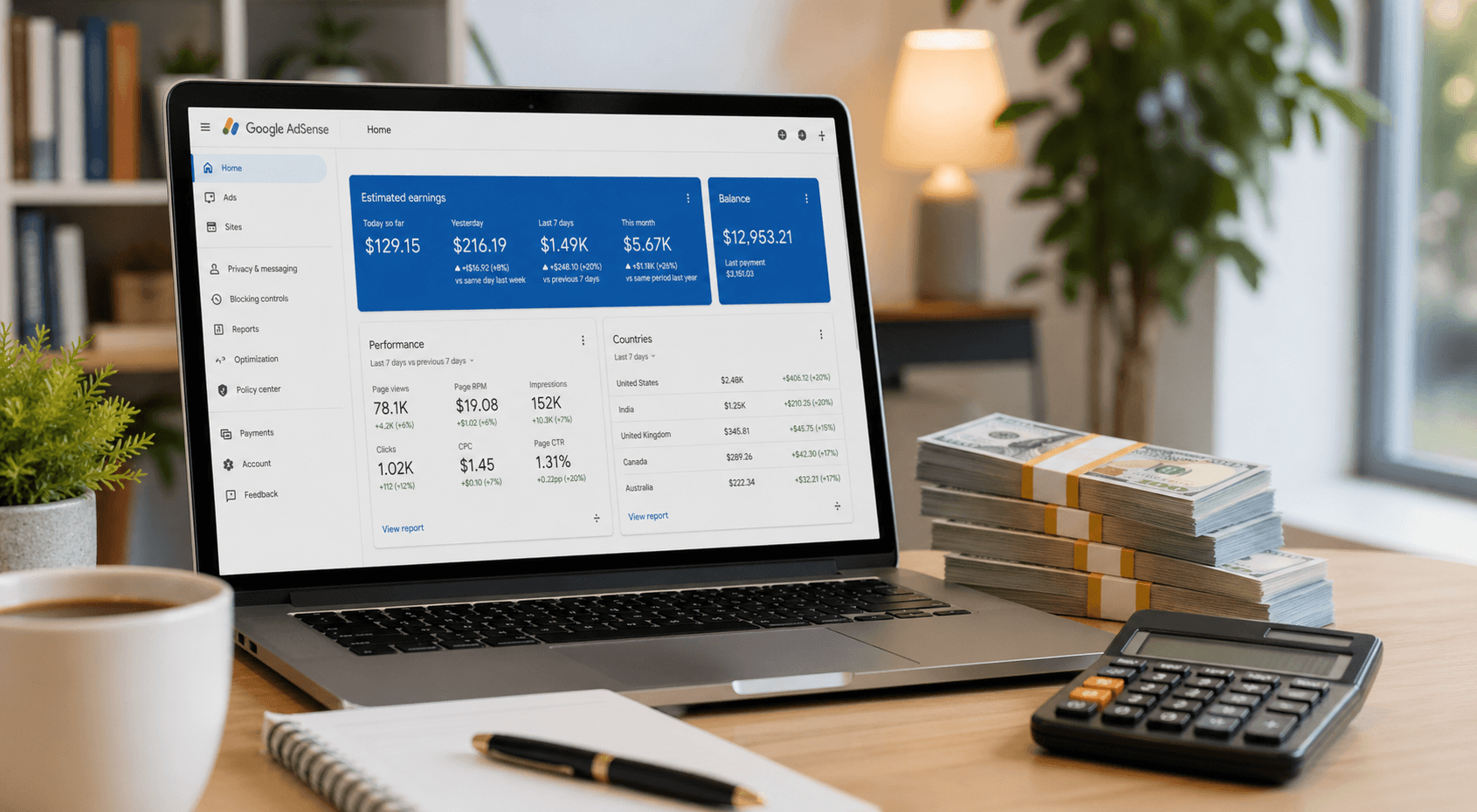
Once your blog is approved for an ad network, every page view generates income automatically. My gardening blog earned $19.82 in its first monetized month on Google AdSense with 3,000 to 5,000 monthly pageviews. That number sounds small but it represents a proof of concept. At 50,000 monthly pageviews on a premium network like Mediavine, the same blog earns $500 to $750 per month without writing a single new post. The full breakdown of how AdSense actually pays, with real numbers from my own account, is here: How Much Money Can You Make With Google AdSense.
Affiliate Marketing
This is the same affiliate marketing I tried and failed at before. The difference is that now I have a platform. Readers come to my blog because they searched for something specific, read an article that answered their question, and trust the recommendation that follows. When I link to a product on Amazon because it is genuinely the right tool for what they are trying to do, a percentage of those readers click and buy. No cold pitching. No link dumping in comment sections. Just useful content with relevant recommendations embedded naturally.
Digital Products
I packaged the exact Pinterest system that produced these results into a guide and sell it for $9.99. One product. Created once. Sells repeatedly without any additional work from me. This is something you can do on any blog once you have built genuine expertise in your niche.
Services
Because my results are documented publicly with real numbers, people reach out and hire me to set up their Pinterest accounts. I go into their account, set up their boards correctly, schedule a month of pins, and hand the account back. That adds around $300 a month on top of the passive income without requiring cold outreach or any kind of performance. The work finds me.
The point nobody makes clearly enough: Dropshipping requires constant ad spend to maintain traffic. Freelancing requires constant client acquisition. Affiliate marketing without a platform requires constant link pushing with no compounding. Blogging requires consistent effort upfront and then compounds quietly for years. The reason it seems boring is the same reason it works.
What to Do If You Want to Start
I get asked this often enough that I want to answer it directly and specifically, not with vague encouragement but with the actual sequence that produced these results.
Start your blog first. Pick a niche with real search demand, set up WordPress, and start writing. The blog is the asset everything else points back to. Without it, Pinterest is just a mood board.
Write at least 20 high quality posts before you touch Pinterest. You need enough content to build proper boards and rotate pins without repeating the same URLs constantly. Pinning too early with too few posts is one of the fastest ways to get flagged by Pinterest's spam detection.
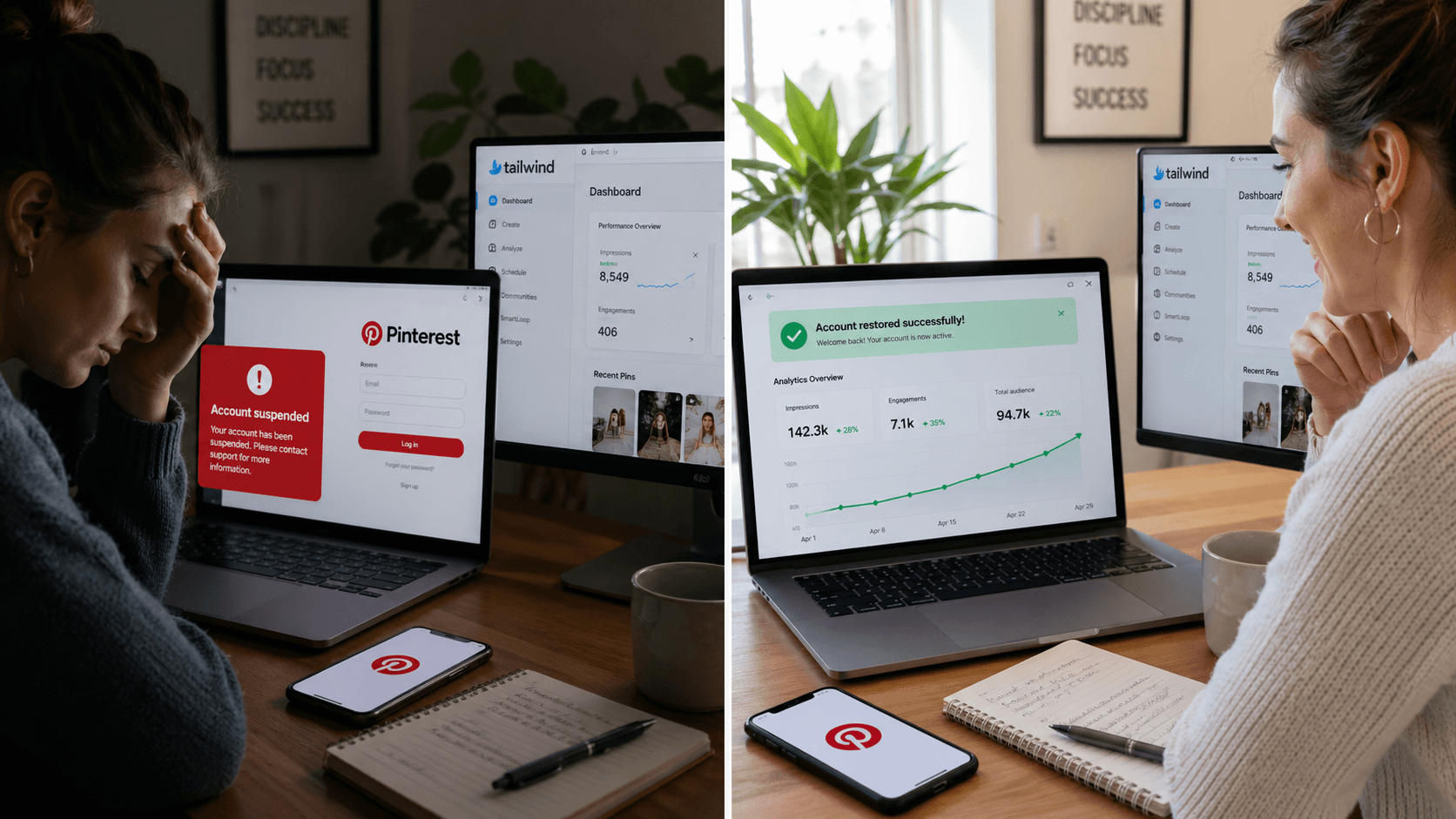
Follow Pinterest best practices from day one. This means no URL repeats within at least 6 days, tightly themed boards, keyword-rich descriptions, and fresh pins rather than repins. The algorithm rewards accounts that behave like real content creators, not schedulers. I learned this the hard way when my account got suspended in month one — here is exactly what happened and how I got it back in two days.
Internal link heavily. Every post should link to at least three other posts on your site. A reader who views three pages generates three times the ad revenue and is far more likely to convert on affiliate links. Internal linking is the highest-leverage low-effort improvement available to any blog at any traffic level.
Pin 5 times per day consistently. Not 20 pins on Monday and nothing for a week. Consistent daily activity. Pinterest's algorithm reads consistency as a signal of a legitimate active account. That consistency is what builds the compounding effect.
Keep writing while the pins work. Pinterest buys you time while Google evaluates your domain. Use that time to keep publishing. When Google does eventually start ranking your posts, you will have a site with real traffic history, genuine engagement signals, and content depth that new sites cannot compete with.
My first dollar from the gardening blog came three months in. Not in the first week. Not the first month. Three months of consistent publishing and pinning before the income became real. Anyone who tells you the timeline is faster than that is either exceptional or not being honest with you.
Want Me to Set This Up For You?
I offer a done-for-you Pinterest Launch Sprint where I set up your entire Pinterest presence in one week, schedule 30 days of high-intent pins, and hand you a running traffic engine. The same system that produced 85,000 impressions and 1,320 outbound clicks in 35 days on a brand new account.
What is included:
- Pinterest Business account setup and full optimisation
- Keyword research for every post on your blog
- Custom board architecture built around your content clusters
- 4–5 branded Canva pin templates designed for clicks
- 30 days of pins designed and scheduled
- Week 4 growth report with next steps
One-time fee: $497. No monthly subscriptions. No upsells on the call.
If you would rather do it yourself, the exact system is documented in the Pinterest Traffic Guide for $9.99. One HTML file, instant download, free tools only.
The Honest Picture
I am not earning thousands of dollars a month yet. I am at $400 passive plus $300 from client work, and both numbers are still growing. I am 22 years old, running three blogs from home in Ghana, building something that compounds every month without requiring cold pitches, networking events, or a personality I do not have.
The methods I tried before this, freelancing, dropshipping, affiliate without a platform, YouTube automation, they all have ceilings that require constant active input to maintain. What I have built with blogging and Pinterest has a different relationship with time. The work done last year is still paying me this year. The pins scheduled last month are still sending traffic this month. That is the actual difference.
Blogging seems boring. That is the point. The boring things are where the quiet, sustainable money is. Everyone chasing the exciting methods is fighting the same crowded rooms. The blog you start today in a specific niche, built around real search demand, driven by Pinterest traffic from week one, is the version of this that actually works without requiring you to become someone you are not.
Start with 20 posts. Pin consistently. Let it compound.
Kamal Deen builds niche blogs and grows them with Pinterest and SEO. The numbers referenced in this article come from his own sites, unedited.