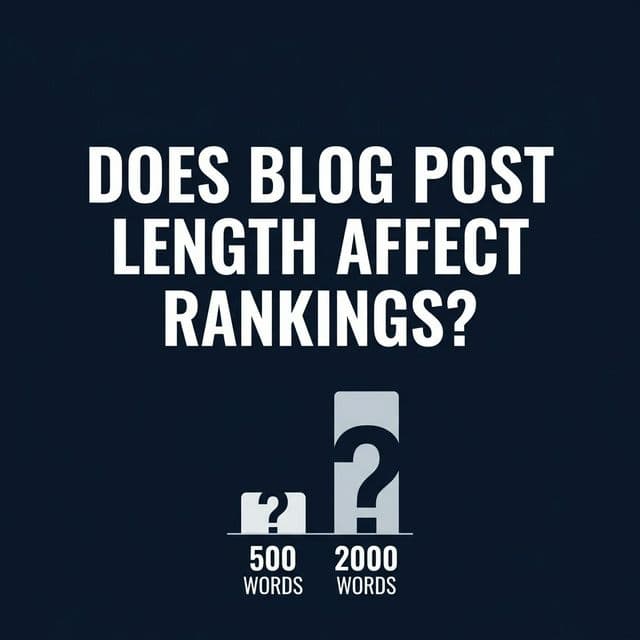
Here is the most common question new bloggers ask after reading their first SEO guide:
"How long should my blog posts be?"
The answer they usually get is "at least 1,500 words" or "long-form content ranks better." That answer is incomplete. In some cases, it is actively misleading.
This article breaks down what the research actually found, what Google has confirmed about word count, and how to make a sensible decision about post length without chasing an arbitrary number.
What Google Says About Word Count
Google has stated clearly, through multiple Search Relations team members, that content length is not a direct ranking factor. The message from their public communications has been consistent: write as much as the topic requires, not as much as an SEO guide tells you to.
John Mueller, Google's Search Relations lead, put it directly in a Reddit AMA: "More text doesn't make a better page." He has repeated versions of this in various Google Search Central podcast episodes and office hours sessions over the years.
The underlying logic is straightforward. Word count is easy to manipulate. A 3,000-word post padded with repetition and filler satisfies a word count target while offering the reader nothing. Google's ranking systems are built to evaluate usefulness, not volume.
What the Data Shows (and What It Does Not Prove)
In 2020, Backlinko and Ahrefs jointly analyzed 11.8 million Google search results. It is one of the largest content studies published on this topic.
What they found:
- The average first-page result was 1,447 words long
- Longer content earned more backlinks than shorter content
- Word count was evenly distributed among positions 1 through 10 on page one
That last point is the one that rarely gets quoted. Once content reaches page one, there is no meaningful relationship between word count and ranking position. A 900-word page has a similar chance of ranking #1 as a 2,500-word page, assuming both made it to page one.
The 1,447-word average is a correlation. It is not a prescription.
| Finding | What It Means |
|---|---|
| Average first-page result: 1,447 words | Long-form content dominates page one overall |
| No relationship between word count and position within page one | Length does not determine where you rank once you are there |
| Longer content earns more backlinks | Comprehensiveness, not word count, drives link acquisition |
Why the Correlation Exists
The real question is: why does long-form content tend to reach page one in the first place?
The answer is not that Google rewards length. The answer is that comprehensiveness and length usually move together.
A post that fully covers a topic, addresses follow-up questions, provides examples, includes data, and anticipates objections will naturally be longer than a post that skims the surface. Google rewards the comprehensive version because it satisfies searcher intent better.
The causality runs in this direction:
Comprehensiveness drives rankings. Length is the side effect of comprehensiveness.
If you could write a comprehensive, genuinely useful post in 600 words, that post would rank just as well as a 2,000-word version covering the same ground less efficiently.
The problem is that most topics cannot be covered comprehensively in 600 words. Which is why longer posts tend to rank. Not because they are longer.
When Short Posts Outrank Long Ones
Short content ranks well in several situations:
When the query is simple and direct. Someone searching "what is a 301 redirect" wants a clear, fast definition. A 300-word post that answers the question cleanly will outperform a 2,000-word post that takes 400 words to get to the point.
When the top-ranking results are already short. Before writing any post, search your target keyword and look at what is ranking. If the top three results are 600 to 800 words, that is Google telling you what length satisfies searcher intent for that query. Matching it is the right starting point.
When the topic has a narrow scope. A post on a highly specific long-tail keyword does not need to cover adjacent territory. It needs to answer one precise question thoroughly.
How to Actually Decide Post Length
Do not start with a word count target. Start with the search results page.
Step 1: Search your target keyword and note the approximate length of the top three results.
These posts ranked because Google judged them as satisfying the searcher's intent. Use their length as a baseline, not as a ceiling or floor.
Step 2: Identify what topics the top posts cover.
Open the three ranking posts and note their main sections. These sections represent what Google considers relevant territory for this query. Your post should cover the same ground, plus any gaps you can see.
Step 3: Write until the topic is covered, not until you hit a count.
Stop when the reader has everything they need. If that is 800 words, publish 800 words. If the topic requires 2,500 words to cover properly, write 2,500 words.
Step 4: Cut aggressively before publishing.
Every sentence that does not add information for the reader is a sentence that dilutes the quality of the post. The final word count should be whatever survives a genuine edit pass, not whatever you wrote in your first draft.
The Backlink Connection
One finding from the Backlinko and Ahrefs study is worth flagging separately: longer content earned significantly more backlinks than shorter content.
This is separate from rankings. A post does not need backlinks to rank, especially for low-competition keywords. But backlinks matter for building domain authority over time, and for ranking on competitive terms eventually.
Why does longer content earn more links? Two reasons.
First, comprehensive posts are more likely to contain data, frameworks, or unique perspectives that other writers want to reference. A 400-word overview rarely contains anything worth citing. A thorough breakdown often does.
Second, longer posts tend to rank for more keyword variations, which means more people discover them through search, and more potential linkers find them in the first place.
If backlink acquisition is part of your strategy, writing thorough, data-backed pieces on your core topics is more likely to produce results than writing shorter posts at higher volume.
The Practical Summary
| Situation | Recommended Approach |
|---|---|
| Simple, direct query (definitions, quick how-tos) | Match the length of ranking results, likely 400 to 800 words |
| Competitive informational keyword | Write comprehensively, 1,200 to 2,000+ words, cover all relevant subtopics |
| Long-tail, low competition keyword | Answer the question completely, prioritize clarity over length |
| Building a linkable asset | Write the definitive resource, include original data or frameworks |
Bottom Line
The 1,500-word minimum advice is not wrong in the sense that it usually produces more comprehensive content than a 500-word post. It is wrong in the sense that it treats word count as the goal rather than comprehensiveness.
Write what the topic requires. Audit the search results page before you write a single word. Cut anything that does not serve the reader.
If your post is the most useful answer to the question being searched, the word count will take care of itself.
For more on building content that ranks, see the 10 SEO fundamentals that actually matter for new bloggers and why the technology stack you build on affects your rankings more than most people admit.