Most SEO advice for new bloggers is structurally flawed. It tells you to find keywords with low competition and high search volume, write an article, and wait.
If your blog is 20 days old, this strategy will fail.
Google evaluates content on a framework known as E-E-A-T (Experience, Expertise, Authoritativeness, and Trustworthiness). A brand new domain has zero authority and zero trust. If you write one article about "personal finance apps", one about "WordPress hosting", and one about "dog training", Google has no clear signal about what you are an expert in.
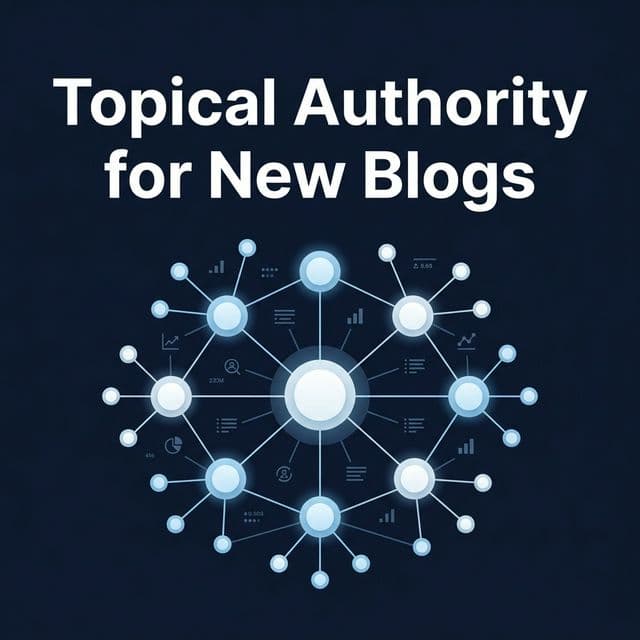
The solution is not to write better isolated articles. The solution is to build topical authority.
What is Topical Authority?
Topical authority is a measure of your perceived expertise on a specific subject. It is completely distinct from Domain Authority (a third-party metric created by Moz based largely on backlink volume).
A site with a Domain Rating (DR) of 80 like Forbes might publish one article on how to start a niche site. A brand new blog with a DR of 5 might publish 40 interconnected, highly detailed articles covering every aspect of building, monetizing, and scaling a niche site.
Google's algorithms will recognize the DR 5 blog as the topical authority. When someone searches for a hyper-specific query about a niche site framework, Google prefers the site that has proven it understands the entire ecosystem, not the generalist publication.
The Data Behind the Strategy
Why do new blogs need topical authority so desperately? Because the default ranking landscape is brutally slow.
| Metric | The Reality for New Content | Source |
|---|---|---|
| Top Ranking Pages > 3 Years Old | 72% of results ranking #1 to #10 | Ahrefs Database Study |
| New Pages Ranking in Top 10 (Year 1) | 6.11% of all new English content | Ahrefs Database Study |
| Domains Hitting Top 10 Within 6 Months | Only 19% | Semrush 28k Domain Study |
If 72% of page-one results are over three years old, a new blog is playing a game tilted heavily against it. You cannot beat a five-year-old article on backlink profile or domain age.
You beat it by completely blanketing the topic category so thoroughly that Google's semantic index cannot ignore you.
The Hub and Spoke Model
The mechanism for building topical authority is the hub-and-spoke content model.
The Hub (Pillar Page): This is a comprehensive, broad overview of your core topic. It covers everything at a high level but does not get dragged into the weeds on any single point.
The Spokes (Cluster Pages): These are hyper-specific articles that target long-tail keywords. They dive deep into a single subtopic that was briefly mentioned in the hub.
The Links: Every spoke links back up to the hub. The hub links out to every single spoke. Spokes link to each other when relevant.
This structure tells search engine crawlers exactly how these pieces of information relate. A case study by WorldReach demonstrated that Google typically detects and processes new internal links within 24 to 48 hours. Strategic internal linking across a tightly clustered topic has been shown to improve rankings for category pages within days or weeks, not months.
A Real-World Example: This Blog
Let us look at how I am structuring my own site's content architecture to build topical authority in the blogging and monetization space.
I do not write random articles. I am building a cluster around "Affiliate Marketing for Bloggers."
The hub is a comprehensive guide explaining the foundational mechanics: How Affiliate Marketing Works.
The spokes answer every highly specific question a beginner has about the system:
- A data breakdown on Affiliate Cookie Durations
- A tactical guide on evaluating the $80 Benable Payout Threshold
- A highly specific, data-backed comparison of Benable vs Amazon Associates
Every spoke points back to the fundamentals. The hub links to the deep dives. If a new competitor writes just one post about affiliate marketing, Google weighs their single article against my interconnected, mathematically linked library. I win the topical authority calculation.
How to Execute This on a New Blog
If your blog is under six months old, follow this exact sequence to force Google to understand your topical authority.
1. Map the Cluster Before You Write
Do not write whatever comes to mind on a Tuesday morning. Pick one parent topic and outline the hub post. Then, identify 10 to 15 long-tail, low-competition questions related to that topic. Those are your next 15 blog posts.
2. Publish Spoke Content First
Write the highly specific, low-competition articles first. These have the highest probability of ranking quickly because the difficulty is low. If you search the term and the top results are weak forums or irrelevant sites, attack that keyword.
3. Weave the Internal Web
As you publish the third and fourth spoke posts, link them to each other wherever perfectly relevant. If you mention cookie durations in a post about Amazon, link to your dedicated cookie duration post.
4. Cap it With the Hub
Once you have 5 to 10 spokes published, write the massive hub article. Link out to your existing spokes for the deep details. Go back into your 10 spokes and update them to link up to the new hub.
You now have a self-contained, highly authoritative cluster. Google's crawlers will enter one page, follow the links, and process the entire network.
The Timeline for Results
Topical authority is not a shortcut to overnight success. It is a structural advantage that compounds over time.
When you publish an isolated post, it waits in line. When you publish the 12th post in a tightly knit topic cluster, it inherited the internal link equity and topical relevance of the previous 11 posts.
New blogs should not expect massive organic search traffic in the first three months. But by month six, a site with two fully mapped, deeply linked topic clusters will drastically outperform a site with 50 random, disconnected articles.
If you are trying to rank a new site, stop chasing random keywords. Pick one neighborhood and own every house on the block.