
If your Pinterest strategy is "do what you do for Google but with images," this post will explain why that is not working.
Pinterest and Google are both search engines. Searchers type keywords into both. Both show results. Both drive traffic to your website if you optimize correctly.
But the mechanism behind each one is almost entirely different. The signals they reward are different. The timeline for results is different. The kind of reader each one sends you is different. Treating them the same means you are probably underperforming on at least one and possibly both.
Here is the breakdown of what actually separates them, written for bloggers who are running both strategies at once.
The Fundamental Difference: Intent Timing
The most important distinction between Pinterest and Google is when in the buyer or reader journey each platform captures attention.
Google captures people who know what they want right now. Someone who searches "how to fix overwatered tomato plant" on Google has an immediate problem they need solved. They are in action mode. They want the answer fast, and if your article gives it to them clearly, they will read it, possibly save it, and maybe visit again later.
Pinterest captures people who are in planning mode. Someone who saves a pin titled "Container Tomato Growing Guide" is not necessarily starting a tomato project today. They are building a mental library for a project they intend to start. Pinterest is a discovery and inspiration platform that functions as a visual search engine. The intent is looser, the timeline is longer, and the content that performs best is the kind that makes someone think "I want to do this eventually" rather than "I need to solve this right now."
This distinction has practical implications for how you write and design content for each platform. Google-first articles are often detailed, structured with headers optimized for scanning, and focused on directly answering a specific question. Pinterest-first pins are visual first, promise-driven, and oriented toward aspiration or transformation rather than immediate problem solving. The design principles for Pinterest-first pins are covered in Pinterest Canva Pin Templates: What Sizes and Formats Actually Work in 2026.
The good news: one article can serve both audiences. The article provides the depth Google wants. The pin provides the visual hook Pinterest rewards. You do not need separate content. You need the right pin pointing to the right article.
Ranking Speed: Days vs Months
This is the practical reason Pinterest matters so much for new blogs.
Google ranks new content slowly. A brand new domain publishing a perfectly optimized article will generally not see meaningful organic traffic from that article for three to six months, sometimes longer. Google is evaluating your domain's trustworthiness, the quality of your content relative to established competitors, and the behavioral signals from whatever traffic you already have. For a site with no history, no backlinks, and no audience yet, that evaluation takes time.
Pinterest ranks new content fast. A well-optimized pin published to a relevant board on a new account can appear in search results and feed distribution within days. Pinterest is not heavily penalizing new accounts the way Google penalizes new domains. The algorithm is evaluating individual pins on their merits, which means a strong pin from a fresh account has a genuine shot at appearing in results before a weak pin from a large established account.
This speed differential is the entire argument for prioritizing Pinterest during a new blog's first year. You need traffic before Google decides you are trustworthy. Pinterest provides it.
I was getting thousands of visitors per month from Pinterest on my gardening niche blog while Google was still sending fewer than ten visitors per day. That is not unusual for a new blog in its first six months. The full story of how that traffic built month by month is in How I Got 200,000 Pinterest Impressions in Under 4 Months, and the direct comparison of when each platform started delivering is in Pinterest Traffic vs Google Traffic for a New Blog: Which Came First for Me.
Ranking Signals: What Each Platform Rewards
Google rewards:
Content depth and quality. A comprehensive, well-researched article covering a topic thoroughly outperforms a shallow treatment of the same topic.
Backlinks. External sites linking to your content are a major trust signal. New blogs have almost none.
Domain authority. How established and trusted your overall site is. Builds over time.
Technical SEO. Site speed, mobile optimization, structured data, internal linking structure.
User behavior signals. If people click your result, read the article, and stay on the page, Google reads those as positive signals. If they click and immediately return to Google, that is a negative signal.
Pinterest rewards:
Freshness. New pins get tested in distribution. Pinterest actively favors accounts publishing fresh original content over those primarily repinning old content.
Visual quality. A pin's image determines whether it gets clicked. Pinterest's algorithm reads engagement signals, and clicks and saves start with the visual before anything else.
Keyword relevance. Pin titles, descriptions, board names, and profile bio all feed the algorithm's understanding of what your pin is about and who to show it to. The keyword research process I use, entirely free and done inside Pinterest itself, is in Pinterest Keyword Research for Bloggers: How I Find Low-Competition Keywords. No backlinks required.
Engagement signals. Saves are the most powerful signal because they tell Pinterest that users found your content worth bookmarking. Outbound clicks tell Pinterest your pin is generating real traffic to real content. Both signal quality content worth distributing further. The full breakdown of how these metrics interact is in Pinterest Impressions vs Clicks vs Saves: What Actually Matters for Blog Traffic.
Account consistency. Pinterest evaluates account behavior over time. Consistent daily pinning builds algorithmic trust faster than irregular bursts.
Keyword Research: The Same Goal, Completely Different Methods
On Google, keyword research uses tools like Semrush, Ahrefs, or Google Keyword Planner to find terms with measurable search volume and evaluable competition metrics. You are working with numbers.
On Pinterest, keyword research is done inside Pinterest itself, using the search bar autocomplete, guided search tiles, Pinterest Trends, and the Ads Manager keyword tool. There is no keyword difficulty score. There is no DA threshold. You are reading search results pages and making judgment calls about what you see. The full step-by-step process for how I find low-competition keywords is in Pinterest Keyword Research for Bloggers.
Content Shelf Life: Evergreen vs Compounding
A Google article ranking on page one generates roughly consistent traffic over time. If its position holds, traffic is relatively predictable.
A Pinterest pin's performance is different. A pin published today might generate ten impressions this week, fifty next month, and three hundred six months from now as it accumulates saves and gets recirculated through feeds. Pinterest pins compound over time in a way that most content does not.
This is both an advantage and a reason why results on Pinterest look slow early on. Month one impressions are almost always low. The pins are not dead. They are accumulating the early engagement signals that eventually trigger wider distribution. The compounding starts to become visible around month two or three, which is when most people who quit actually had a strategy that was working.
The Relationship Between Pinterest and Google (This Is the Part People Miss)
Pinterest and Google are not competing traffic sources for a new blog. They are sequential.
When Pinterest sends real visitors from real countries to your new blog, Google sees that traffic. Google sees that humans are finding and reading your content. Those behavioral signals feed directly into Google's trust evaluation of your domain.
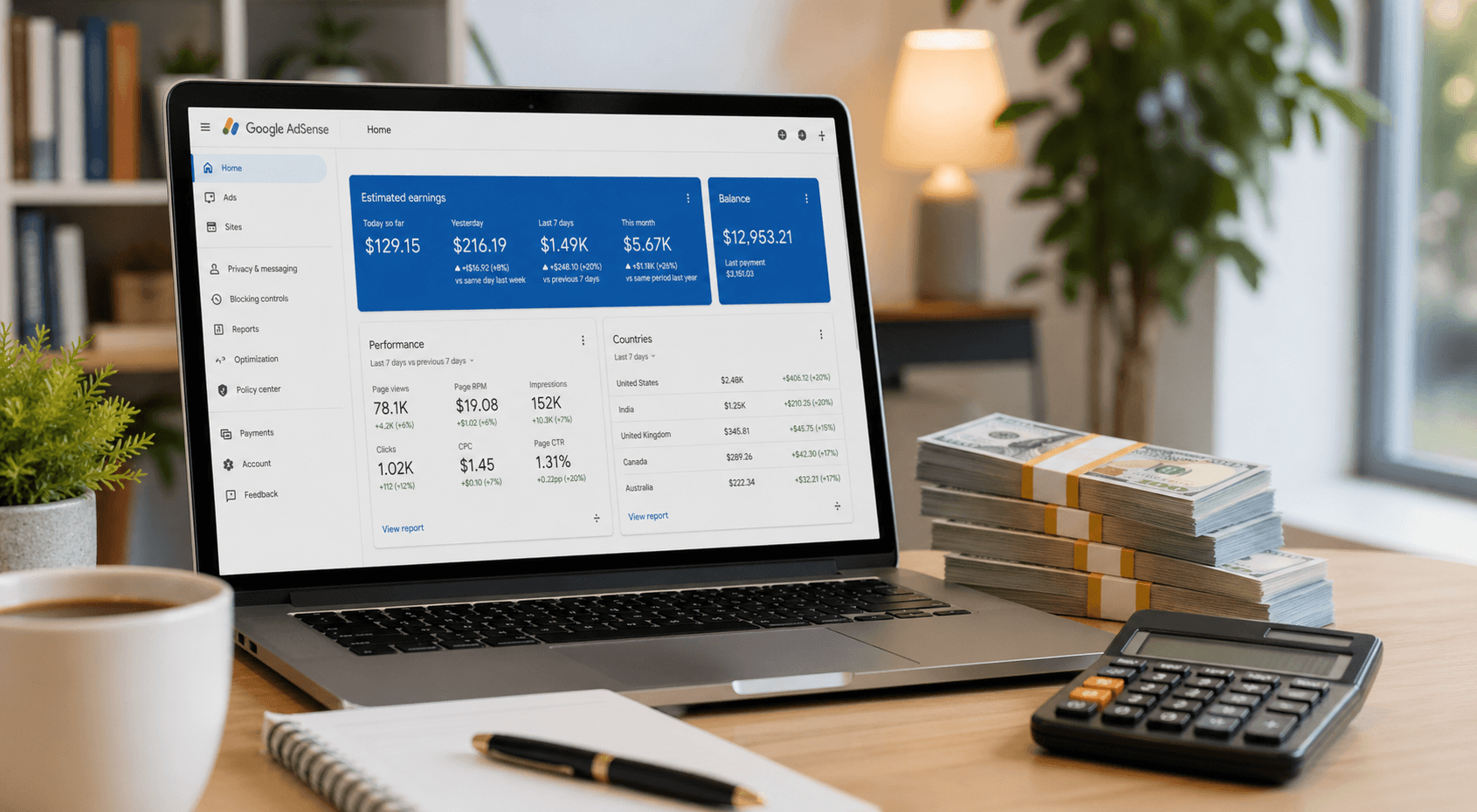
My AdSense application getting approved faster than I expected was partly because Pinterest had been sending traffic from tier 1 countries (US, UK, Australia) for months before I applied. Google saw that. Real people reading content from established geographic markets is exactly the kind of signal that accelerates a new domain's trust evaluation.
The sequence: Pinterest builds real traffic first. That real traffic builds the Google trust signals. Google trust signals lead to organic rankings. By the time Google starts ranking you, you already have a functioning traffic source and real engagement data on which of your content people actually read.
This is why "Pinterest first, Google follows" is not just a catchy phrase. It is the actual correct order of operations for a new blog. And if you want to understand exactly what Pinterest traffic actually converts to in revenue while you wait for Google to show up, Does Pinterest Traffic Convert? covers the honest numbers.
The Quick Comparison Table
| Factor | Google SEO | Pinterest SEO |
|---|---|---|
| Traffic speed for new sites | 3-6 months minimum | Days to weeks |
| Main ranking signals | Backlinks, domain authority, content depth | Freshness, visual quality, keyword relevance, saves |
| Keyword research tools | Semrush, Ahrefs, Google Keyword Planner | Pinterest search bar, Guided tiles, Trends |
| Content format priority | Long-form text, structured headers | Vertical visual, compelling image, bold text overlay |
| Shelf life | Stable if ranking holds | Compounding over months |
| Follower count importance | N/A | Very low, Pinterest is search-driven |
| New account disadvantage | High (domain authority takes time) | Low (pins evaluated on individual merit) |
For Bloggers Running Both: The Practical Integration
You do not need to choose between Pinterest and Google. You need to write articles with enough depth and structure to satisfy Google, then create multiple pins for each article that satisfy Pinterest.
The article does the Google work. The pin does the Pinterest work. The link between them is the URL.
This is why the cluster approach I am building around Pinterest topics works on both platforms simultaneously. Long-form, well-structured articles with original data and personal experience satisfy Google's EEAT requirements. Visual pins with keyword-specific descriptions and compelling design drive Pinterest distribution. Same content, two traffic channels, reinforcing each other.
If you want to see the full system that brings both together, account setup, keyword research, pin production, CSV scheduling, and analytics review, Pinterest for Niche Site Builders: My Complete System documents every piece of it.
Kamal Deen builds niche blogs and grows them with Pinterest and SEO.