
When you start a new blog, Google is not interested in you yet.
That is not a criticism of your content or your niche. It is just how the system works. Google runs new domains through a trust evaluation period that typically lasts three to six months. During that window, your articles get indexed but they do not rank. You can write perfectly optimized content every single week and your organic search traffic will still be nearly zero.
This is the wall that stops most new bloggers from ever seeing results. They build something, they wait for Google, Google takes its time, they interpret the silence as failure and quit.
Pinterest is what gets you through that window.
Not because Pinterest is easier to succeed on. Not because the traffic is unlimited or because you can go viral with one pin and retire. But because Pinterest evaluates content differently from Google, rewards fresh accounts much faster, and can deliver real traffic to a new blog while you are still in that Google evaluation period. I covered the structural reasons behind why these two platforms behave so differently in Pinterest SEO vs Google SEO: What's Different and Why It Matters for Bloggers.
This is the exact way I used it.
Why a New Blog Has No Leverage on Google
Domain authority is a metric that attempts to quantify how much trust Google has in your website based on its age, backlink profile, content history, and user behavior signals. New sites have almost none of it.
Google uses this trust evaluation to filter content. Two articles covering the same topic with equivalent quality: the one from the established domain with years of backlinks and proven user engagement ranks higher. The one from the three-month-old blog with no backlinks ranks lower, possibly several pages lower.
This filtering is not arbitrary. It exists because without it, any site could publish anything and immediately claim page one. The trust filter protects the search results from being flooded with low-quality new content.
The problem for new bloggers is that this filter also slows down good new content from legitimate new sites. You can publish excellent articles and still see almost no Google traffic for months. My own site currently gets around three Google visitors per day. The blog is still establishing its domain authority and Google is still building its trust picture of the site.
Pinterest does not have this filter.
What Pinterest Actually Evaluates
Pinterest is a visual search engine. When you publish a pin, Pinterest shows it to a small test audience relevant to its keywords. If that test audience saves it, clicks it, or engages with it, Pinterest distributes it more widely. If the test audience ignores it, Pinterest distributes it less.
Nowhere in that process does Pinterest check your domain authority. Nowhere does it evaluate whether your website has been online for more than six months. Nowhere does it penalize you for not having backlinks from established sites.
A fresh Pinterest account, publishing well-optimized pins with strong images and keyword-specific descriptions, has a real chance of generating impressions and clicks in its first weeks. Not months. Weeks.
The First 100 Visitors
The first meaningful milestone I hit from Pinterest was the first 100 visitors to my gardening niche blog. That happened early, before Google had sent more than a handful of visitors from any organic search.
Those 100 visitors were real people. People from real countries, largely the US and UK, who found a pin in a search or a feed recommendation, liked what they saw, and clicked through to read an article.
That sounds small and it is small in absolute numbers. But consider what those 100 visitors represent in context:
Google saw those 100 visitors arriving on the site. Google saw that they came from an external source (Pinterest), that they spent time on pages, and that they were from tier 1 countries. These are signals that a real, legitimate website is attracting a real audience. Those signals fed directly into my AdSense application, which got approved faster than I expected for a site at that age.
Every 100 visitors from Pinterest is not just 100 visitors. It is 100 engagement signal data points feeding Google's evaluation of your domain's trustworthiness.
The Setup That Made It Work
I did not arrive at Pinterest and start posting randomly. The account was set up deliberately before a single pin was published.
The foundation steps that mattered:
Pinterest Business account with the website claimed. Every pin linking to my domain got attributed to my account automatically. Attribution builds the trackable record of my content on the platform over time. The full setup walkthrough, including how to claim your website, write your profile bio with keywords, and configure your boards for maximum algorithmic signal, is in How to Set Up a Pinterest Business Account for a Blog.
Boards structured around searchable keyword phrases. Not "My Garden Posts" but "Veggie Garden" and "Container Gardening." The board names tell the algorithm exactly which audience to show my pins to. The full board strategy I use, including why one board ended up driving most of my growth, is in Pinterest Board Strategy for Niche Blogs.
Profile bio written with keywords. Not a personal introduction. A topically specific description of what the account covers and who will find it useful.
This setup, done before the first pin, gave every subsequent pin the strongest possible algorithmic foundation.
The Pinning Strategy for a Blog With No Existing Traffic
When you are starting with zero, the question is not how to amplify an existing audience. The question is how to get the algorithm to start distributing your content to people who have never heard of you.
The answer is volume plus quality plus keyword specificity, sustained consistently over time.
Volume: I started at 5 pins per day and scaled to 10 pins per day by month two. More pins per day means more opportunities for the algorithm to find a pin that resonates with its test audience and begins distributing it more widely. The full analysis of pin volume and what it produces at each level is in How Many Pins a Day on Pinterest Actually Grows a Blog Account.
Quality: Every pin was an original pin with a strong vertical image (1000 x 1500 pixels), bold readable text, and a specific promise in the headline. No generic stock photos. No vague headlines. Each pin told the viewer exactly what they would get if they clicked. The design principles and Canva workflow I use are in Pinterest Canva Pin Templates: What Sizes and Formats Actually Work in 2026.
Keyword specificity: Every pin title and description targeted a specific keyword from Pinterest search research. Not broad generic terms. Specific, lower-competition phrases where my fresh content had a realistic chance of appearing in search results. The research process, done entirely free inside Pinterest itself, is in Pinterest Keyword Research for Bloggers: How I Find Low-Competition Keywords.
Consistency: This is the part that is genuinely boring to describe but genuinely critical in practice. Consistent daily pinning, sustained for four months, is what built the compounding momentum that produced 200,000 monthly impressions. No single week of heavy pinning would have produced the same result.
What "No Domain Authority" Means for Your Pinterest Strategy
Domain authority matters on Google. On Pinterest, what matters is the quality of your pins and the keyword relevance of your descriptions and boards.
This means your competitive position on Pinterest is much better than your competitive position on Google at the same stage of your blog's development. On Google, a three-month-old blog is competing against sites that have been ranking for years. On Pinterest, a well-optimized fresh pin from a new account competes on roughly equal terms with a pin from an established account if the individual pin quality and keyword targeting are equivalent.
The playing field is not level, but it is considerably more level than Google's playing field for new sites. Pinterest is the arena where a new blog can actually compete.
From First 100 to Thousands Per Month
The first 100 visitors felt like a trickle because it was a trickle. Month one impressions were under 10,000 and the click-through to actual blog traffic was modest.
By month four, the account was at 200,000 monthly impressions and the traffic coming to the blog each month was in the thousands. Not 10 visitors per day. Thousands per month.
The mechanism that produced that growth: early pins accumulating saves, saves triggering wider distribution, wider distribution bringing more saves, older pins continuing to circulate and generate impressions and clicks alongside new pins being published daily. Compounding.
The moment where the compounding became visible was month two, when one board started significantly outperforming everything else and impressions jumped fivefold from month one. From that point, the numbers grew month over month without requiring any fundamental change to the strategy.
Full month-by-month breakdown: How I Got 200,000 Pinterest Impressions in Under 4 Months.
The Traffic That Changed My Application
I want to be specific about the AdSense connection because it is one of the most concrete benefits of Pinterest for a new blog that rarely gets mentioned.
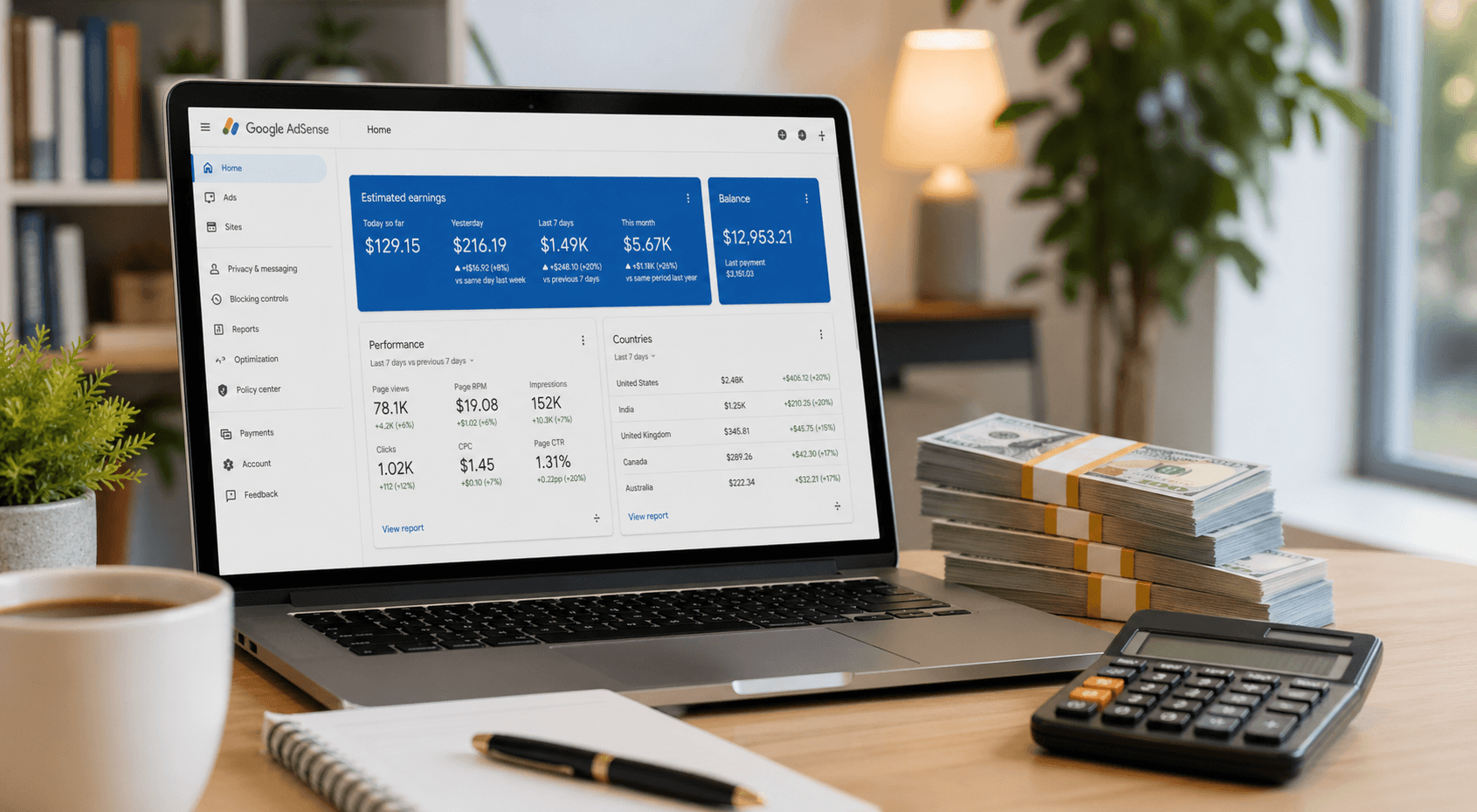
Google AdSense evaluates applications based partly on the quality and consistency of traffic to a site. A site receiving visitors from tier 1 countries (US, UK, Canada, Australia) with engagement that looks like genuine reading behavior is a stronger AdSense application than a site with no meaningful traffic or traffic from sources Google cannot verify.
My Pinterest traffic was delivering visitors from tier 1 countries. Those visitors were reading gardening articles. The engagement patterns looked exactly like what they were: real people finding useful content through a legitimate search platform.
I believe that traffic pattern materially helped my AdSense application get reviewed and approved sooner than it would have been for a site with zero traffic and no engagement history. I cannot prove causation definitively. What I can say is the timeline was faster than most new bloggers report for sites without prior traffic.
Pinterest did that. Google search traffic was still essentially zero at the time of my application.
Kamal Deen builds niche blogs and grows them with Pinterest and SEO.